

What is the bending strength of arrayed diamond segments?
Hey there! As a supplier of Arrayed Diamond Segments, I often get asked about the bending strength of these little wonders. So, I thought I'd take some time to break it down for you.
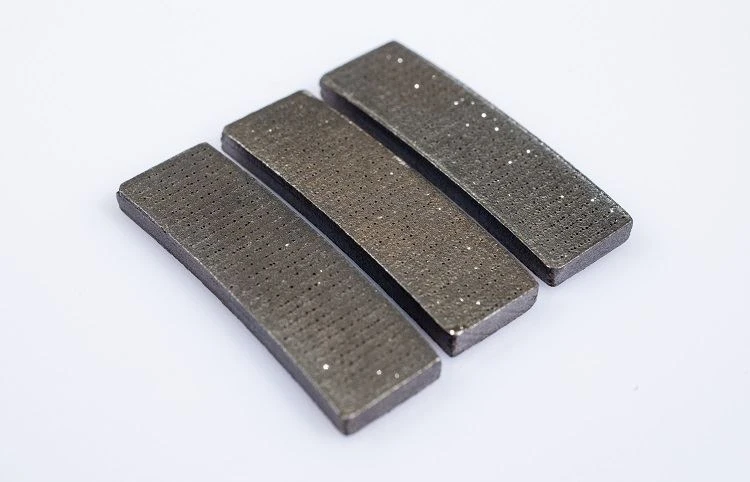
First off, let's talk about what arrayed diamond segments are. These are specialized cutting tools used in the stone - cutting industry, especially for cutting granite. They consist of small diamond particles that are arranged in a specific pattern on a metal matrix. This arrangement gives them some unique properties that make them highly effective for cutting through hard materials.
The bending strength of arrayed diamond segments is a crucial factor. It refers to the maximum amount of stress a segment can withstand before it starts to bend or break. You see, when these segments are used in cutting operations, they are subjected to a lot of pressure. If the bending strength is too low, the segment can easily break or deform, which not only affects the cutting performance but also shortens the lifespan of the tool.
Now, what affects the bending strength of arrayed diamond segments? There are several factors at play here.
1. Diamond Quality and Concentration
The quality of the diamonds used in the segment is a major determinant. High - quality diamonds with fewer impurities are generally stronger and can contribute to a higher bending strength. Also, the concentration of diamonds matters. If there are too few diamonds, the segment may not be able to withstand the cutting forces properly. On the other hand, an extremely high concentration can also cause problems as it may lead to a less homogeneous matrix structure, which can in turn reduce the bending strength.
2. Metal Matrix Composition
The metal matrix is like the glue that holds the diamonds together. Different metals and alloys have different mechanical properties. For example, some metals are more ductile, while others are more brittle. A well - designed metal matrix composition can enhance the bonding between the diamonds and the matrix, increasing the overall bending strength of the segment. Manufacturers often experiment with different metal mixtures to find the optimal combination for a given application.
3. Manufacturing Process
How the segments are made also has a huge impact on their bending strength. Processes like powder metallurgy, which involves compacting and sintering metal powders, need to be carefully controlled. If the sintering temperature is too low, the matrix may not fully densify, resulting in a weaker segment. Conversely, if the temperature is too high, the diamonds may start to graphitize, which also reduces the strength.
When it comes to applications, having a high - bending - strength arrayed diamond segment is especially important in high - speed cutting operations. For instance, when cutting large blocks of Quality Diamond Segment for Hard Granite, the segments need to be able to withstand the rapid and intense forces without breaking. This ensures a smooth and efficient cutting process, saving both time and money for the end - user.
Another area where bending strength is crucial is in the production of Granite Cutting Segment. These segments are often used in continuous cutting operations, where they are constantly under stress. A segment with good bending strength can maintain its shape and cutting edge for a longer time, providing consistent performance.
As a supplier, I'm always looking for ways to improve the bending strength of our Granite Segment. We work closely with our research and development team to test different diamond qualities, matrix compositions, and manufacturing processes. By doing so, we can offer our customers segments that not only have high bending strength but also excellent cutting performance.
But how do you measure the bending strength of these segments? Well, there are standard testing methods. One common way is to use a three - point bending test. In this test, a segment is placed on two supports, and a load is applied at the center until the segment breaks. The maximum load the segment can withstand before breaking is then used to calculate the bending strength.
It's important to note that the bending strength requirements can vary depending on the specific application. For light - duty cutting tasks, a lower bending strength may be acceptable. However, for heavy - duty industrial applications, a much higher bending strength is needed.
So, if you're in the market for arrayed diamond segments, make sure to consider the bending strength. It's not just a technical detail; it can have a significant impact on the performance and longevity of your cutting tools.
If you're interested in learning more about our arrayed diamond segments or have any questions regarding bending strength and other properties, don't hesitate to reach out. We're here to help you find the best solution for your cutting needs. Whether you're a small - scale stone cutter or a large - scale industrial operation, we have the expertise and products to meet your requirements. Contact us today to start a conversation about how our high - quality arrayed diamond segments can improve your cutting processes.

References
- Stone Cutting Technology Handbook
- Journal of Diamond and Related Materials
- International Conference on Abrasive Technology and Cutting Tools Proceedings