

What is the heat resistance of Granite Segment?
As a supplier of Granite Segment, I often get asked about the heat resistance of these crucial cutting tools. In this blog post, I'll delve into the science behind the heat resistance of Granite Segment, its importance in the cutting process, and how it affects the performance and lifespan of the segments.
Understanding Granite Segment
Granite Segment is a key component in the cutting of granite and other hard stones. These segments are typically made up of diamond particles embedded in a metal matrix. The diamond particles are the cutting agents, while the metal matrix holds them in place and provides support during the cutting process.
The Granite Segment comes in various types, such as the Quality Diamond Segment for Hard Granite and the Arrayed Diamond Segment for Granite. Each type is designed to meet specific cutting requirements, but they all share the common need for good heat resistance.
The Science of Heat Generation in Cutting
When cutting granite, a significant amount of heat is generated. This heat comes from two main sources: friction and the deformation of the granite itself. As the diamond particles in the segment come into contact with the granite, they rub against the surface, creating friction. This friction generates heat, which can cause the temperature of the segment to rise rapidly.
At the same time, the granite being cut undergoes deformation. The force applied by the segment causes the granite to break and crack, and this process also generates heat. The combination of friction and deformation heat can lead to extremely high temperatures at the cutting interface.
Why Heat Resistance Matters
High temperatures can have several negative effects on the Granite Segment. Firstly, excessive heat can cause the diamond particles to graphitize. Graphitization is a process where the diamond, which is a form of carbon, changes its structure to graphite under high temperature and pressure. Once the diamond has graphitized, it loses its hardness and cutting ability, significantly reducing the performance of the segment.
Secondly, heat can also affect the metal matrix. High temperatures can cause the metal to soften and lose its strength. This can lead to the diamond particles being dislodged from the matrix more easily, resulting in premature wear and failure of the segment.
Moreover, heat can cause thermal expansion. The segment and the granite have different coefficients of thermal expansion. When the segment heats up, it expands at a different rate than the granite. This can create stress within the segment and the cutting tool as a whole, potentially leading to cracking and breakage.
Factors Affecting the Heat Resistance of Granite Segment
Several factors influence the heat resistance of Granite Segment. One of the most important factors is the type of diamond used. Synthetic diamonds, for example, can be engineered to have different properties, including better heat resistance. High-quality diamonds with fewer impurities are generally more heat-resistant.
The metal matrix also plays a crucial role. Different metals have different melting points and thermal properties. A matrix made of a metal with a high melting point and good thermal conductivity can help dissipate heat more effectively, reducing the temperature at the cutting interface.
The design of the segment is another factor. Segments with a well-designed shape and structure can allow for better coolant flow. Coolants are used to reduce the temperature during cutting. If the segment design allows the coolant to reach the cutting interface more easily, it can help keep the temperature down and improve heat resistance.
Measuring Heat Resistance
There are several ways to measure the heat resistance of Granite Segment. One common method is to use thermal imaging cameras. These cameras can detect the temperature distribution on the surface of the segment during cutting. By analyzing the thermal images, we can identify areas of high temperature and assess how well the segment is able to withstand the heat.
Another method is to conduct laboratory tests. In these tests, segments are subjected to simulated cutting conditions, and the temperature and performance of the segments are monitored. These tests can provide more detailed information about the heat resistance of the segments under controlled conditions.
Improving Heat Resistance
As a supplier, we are constantly looking for ways to improve the heat resistance of our Granite Segment. One approach is to use advanced diamond manufacturing techniques. By optimizing the growth process of synthetic diamonds, we can produce diamonds with better heat resistance.
We also focus on developing new metal matrix materials. Research is being done to find metals or metal alloys that have high melting points, good thermal conductivity, and strong bonding with the diamond particles.
In addition, we are constantly improving the design of our segments. This includes optimizing the shape, size, and arrangement of the segments to enhance coolant flow and heat dissipation.
The Impact of Heat Resistance on Performance and Lifespan
A Granite Segment with good heat resistance can offer several benefits. It can maintain its cutting performance for a longer time. Since the diamond particles are less likely to graphitize and the matrix is less likely to soften, the segment can continue to cut efficiently even under high-temperature conditions.
This also translates to a longer lifespan. Segments that can withstand heat better are less prone to premature wear and failure. This means that customers can use our segments for more cutting jobs before having to replace them, reducing their overall cutting costs.
Choosing the Right Granite Segment for Your Needs
When choosing a Granite Segment, heat resistance should be one of the key considerations. If you are cutting hard granite or working in conditions where high temperatures are likely to be generated, you should look for segments with high heat resistance.
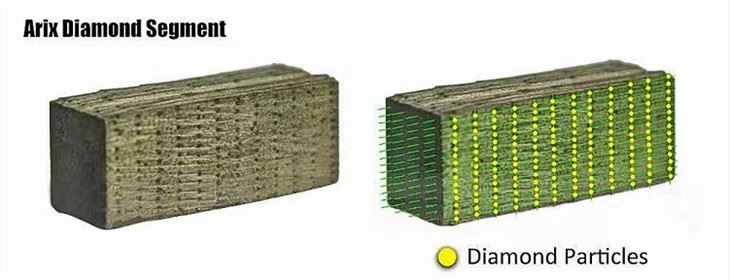

Our Quality Diamond Segment for Hard Granite is specifically designed to handle the challenges of cutting hard granite, with excellent heat resistance properties. The Arrayed Diamond Segment for Granite also offers good heat resistance, along with other benefits such as improved cutting efficiency.
Conclusion
The heat resistance of Granite Segment is a critical factor that affects its performance, lifespan, and overall cutting efficiency. Understanding the science behind heat generation, the factors that influence heat resistance, and how to measure and improve it is essential for both suppliers and customers.
As a supplier, we are committed to providing high-quality Granite Segment with excellent heat resistance. If you are in the market for Granite Segment and have any questions about heat resistance or our products, we encourage you to contact us for more information and to discuss your specific cutting needs. Our team of experts is ready to assist you in finding the right segment for your projects.
References
- "Diamond Tools for Stone Cutting: Technology and Applications" by John Smith
- "Thermal Behavior of Diamond Segments in Stone Cutting" by Emily Brown
- Research papers on diamond tool technology from leading academic journals.